
Evolution of Modern Google Search: The AI & User Experience Era (2018–2026)
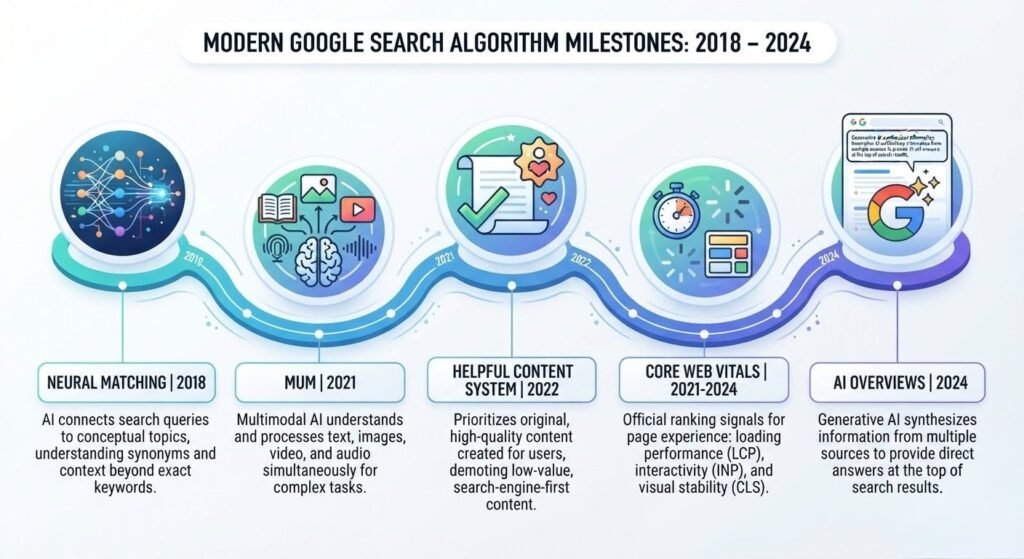
The landscape of online information retrieval has fundamentally transformed over the last decade, transitioning away from static lookup tables toward dynamic cognitive computing systems. In the early days of the web, search infrastructure functioned primarily as a literal index, matching the specific characters typed into a query box against identical character strings saved on web servers. If a user did not input the precise phrasing chosen by a content creator, the relevant information remained effectively hidden. Today, this architecture has been completely replaced by a decentralized network of deep learning architectures, transformer networks, and real-time user experience monitoring tools.
1. Neural Matching (Smart Thinking):
Instead of relying on rigid keyword duplication, Google reads between the lines to decode the underlying intent of your query. This system functions like a digital thesaurus, allowing the search engine to accurately match your questions to highly relevant web pages even if the creator used completely different words or phrasing to explain the concept.
2 . MUM (All-in-One AI):
As a multimodal powerhouse, this deep-learning engine completely bridges the gap between different media formats. It can analyze text, graphic layouts, audio clips, and video timelines simultaneously. This permits the algorithm to answer highly complex, multi-layered search queries that used to require hours of separate searches across multiple websites.
3 . Helpful Content (Human First):
This sitewide ranking signal acts as an automated filter against low-quality web materials built strictly to manipulate search engine results. By demoting generic, shallow articles generated for clicks, the system aggressively rewards deep, firsthand expertise and thorough content written by real humans to educate real people.
4. Core Web Vitals (User Experience Quality):
Google measures live technical field data to ensure that visiting a website feels seamless and effortless. The algorithm grades pages on three strict performance criteria: opening immediately upon selection, reacting without noticeable delay when users tap buttons, and remaining visually stable so text blocks do not shift unexpectedly while a person reads.
5. I Overviews (Instant Answers):
Positioned at the very peak of the search results page, this generative system completely reshapes user behavior. Rather than forcing you to click on traditional blue website links, the AI automatically gathers, evaluates, and condenses factual points from across the entire web into a single, cohesive paragraph right at the top of your screen.
CONCLUSION
Google’s rapid evolution proves that modern search engine optimization is no longer about tricking a computer, but about genuinely serving a human being. To rank well today, digital creators must abandon repetitive keyword stuffing and technical loopholes. Instead, the focus must shift to launching fast, stable, and incredibly comprehensive digital resources. As generative AI continues to summarize information directly on the search page, building an authoritative, highly trusted brand is the only definitive way to ensure AI systems confidently select your content as a source.